La secuencia propone un acercamiento al cuento “Eleven”, de Sandra Cisneros, a través de situaciones de lectura, oralidad, escritura y reflexión sobre el lenguaje. El relato, centrado en Rachel y su cumpleaños, permite abordar temas como la identidad, los vínculos en el aula, la empatía y las emociones que se movilizan al crecer.
Es posible acceder al material para estudiantes en la sección Recursos.
El recorrido parte de la experiencia personal y la anticipación para avanzar hacia una lectura cada vez más atenta al texto. Las actividades proponen formular y revisar hipótesis, relacionar ideas, identificar recursos expresivos e interpretar su sentido. Se busca que las y los estudiantes fundamenten sus respuestas con evidencias a partir del texto.
Las actividades fueron pensadas para ofrecer distintos grados de apoyo: frases para interactuar con pares, imágenes, opciones de respuesta, organizadores gráficos, entre otros. Las intervenciones docentes permitirán sostener la participación de estudiantes con diferente manejo del inglés.y avanzar hacia una mayor autonomía.
* Por razones de derechos de autor, no es posible reproducir la totalidad del cuento. El texto completo forma parte de la colección Woman Hollering Creek and Other Stories publicada en 1991 y puede consultarse en línea: “Eleven”, by Sandra Cisneros. En la web, pueden encontrarse videos de la autora leyendo el cuento: Sandra Cisneros Reads Eleven.
PART A: Before reading
Meet the author
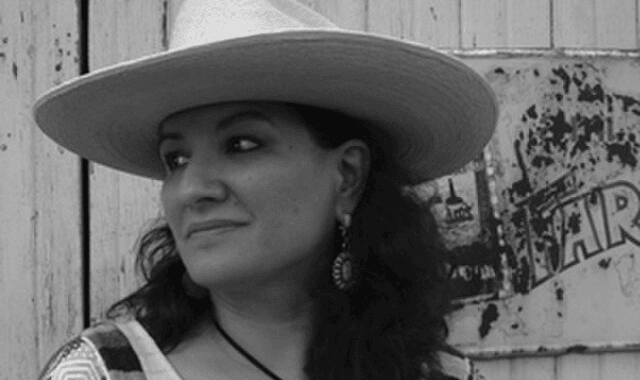
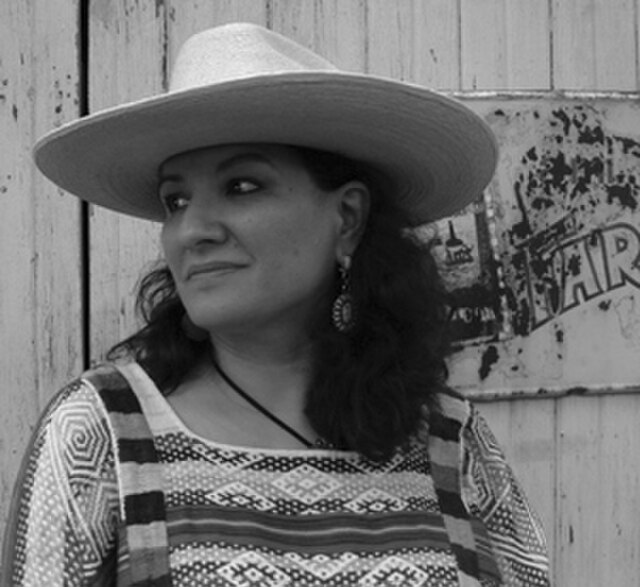
Este primer momento brinda información sobre Sandra Cisneros con el fin de despertar la curiosidad y explorar las representaciones de las y los estudiantes. La fotografía y el nombre de la autora permiten formular hipótesis que luego se contrastan con información breve sobre su vida y obra.
Una vez revisadas las respuestas, cada docente puede invitar al grupo a ampliar la información mediante una búsqueda guiada en el sitio oficial de la autora: Sandra Cisneros – My Life and Work.
Do you know Sandra Cisneros? Look at the photograph and guess
She is awriter / a teacher / an artist.
She is from Argentina / Mexico / the United States.
She speaks onlyEnglish / only Spanish / English and Spanish.
Sandra Cisneros tells stories about people and their experiences / animals and nature / famous historical events.
Foto de la autora. Fuente: Wikimedia Commons.
Now read the text and check your predictions. Which ones were right?
Sandra Cisneros is a Mexican-American writer. She was born in Chicago in 1954, where she grew up speaking Spanish and English. Although she sometimes had a hard time at school, she eventually became a teacher and a famous writer. She also loves to paint!
In many of her stories, Sandra writes about growing up, family, and the experiences of young Latina girls, especially those who feel misunderstood and out of place.
Think ahead
Las preguntas de esta actividad buscan activar experiencias e ideas relacionadas con temas que aparecen en el cuento: el crecimiento, la edad, los cumpleaños. Se sugiere seleccionar las preguntas que resulten significativas para el grupo y que permitan generar interés antes de la lectura.
Read the following questions and think about your answers. Take down some notes.
When we grow up, we gradually become adults. What does "growing up" mean to you?
What changes as we grow up?
Is growing up easy or challenging? Why?
What can be difficult about growing up?
On our birthday, we become one year older, but… do we feel older?
Do you always feel your age?
How old are you? How old do you feel?
Can you feel younger or older sometimes? When?
Birthdays can be special days. What do you usually expect on your birthday?
Do you celebrate your birthday? How?
Have you ever had an unexpected experience on your birthday? How did you feel?
Think-Pair-Share
Esta dinámica permite disponer de un tiempo de preparación para la interacción oral. Se desarrolla en tres momentos: think, cada estudiante lee las preguntas y toma algunas notas; pair, comparte y contrasta sus ideas con una compañera o un compañero; y share, se ponen en común algunas respuestas con el grupo. El word bank funciona como apoyo lingüístico.
In pairs or groups of three, discuss the questions above. Here are some useful words and phrases:
Word bank fun - chores - responsibilities - work - play - help - learn - know - celebrate - party - have fun - blow candles - presents
For me, growing up means...
I don't always feel my age because...
Growing up can be difficult because...
I remember a birthday when...
I felt really sad / angry / upset because...
I agree with you because...
I see what you mean, but I think…
PART B: While reading
Guided reading aloud
Se sugiere que cada docente realice una lectura en voz alta y así ofrecer un modelo de pronunciación, ritmo y entonación. Acercarse al texto desde la escucha favorece la construcción de sentidos cuando la lectura autónoma resulta desafiante. En un texto literario, la lectura expresiva también contribuye a transmitir emociones y a poner de relieve la voz narrativa.
Se recomienda no interrumpir excesivamente el relato durante la primera lectura, priorizando la comprensión global y dejando algunas preguntas o aspectos de vocabulario para momentos posteriores.
Listen to your teacher read the first part of the story. Follow the text and think about Rachel’s ideas and feelings.
Eleven
What they don't understand about birthdays and what they never tell you is that when you're eleven, you're also ten, and nine, and eight, and seven, and six, and five, and four, and three, and two, and one. And when you wake up on your eleventh birthday you expect to feel eleven, but you don't. You open your eyes and everything's just like yesterday, only it's today. And you don't feel eleven at all. You feel like you're still ten. And you are—underneath the year that makes you eleven.
Like some days you might say something stupid, and that's the part of you that's still ten. Or maybe some days you might need to sit on your mama's lap because you're scared, and that's the part of you that's five. And maybe one day when you're all grown up maybe you will need to cry like if you're three, and that's okay. That's what I tell Mama when she's sad and needs to cry. Maybe she's feeling three.
Because the way you grow old is kind of like an onion or like the rings inside a tree trunk or like my little wooden dolls that fit one inside the other, each year inside the next one. That's how being eleven years old is.
You don't feel eleven. Not right away. It takes a few days, weeks even, sometimes even months before you say Eleven when they ask you. And you don't feel smart eleven, not until you're almost twelve. That's the way it is.
Answer the questions. Go back to the text to find the information that you need.
Las preguntas orientan una primera recuperación de información explícita y permiten focalizar algunos aspectos de la voz de Rachel: cómo experimenta su edad y cómo entiende el crecimiento. Se promueve que las y los estudiantes fundamenten sus respuestas con evidencias textuales.
How does Rachel feel about turning eleven? Why?
According to Rachel, can you feel younger than your actual age? What examples does she give?
What three things does Rachel compare growing older to?
How long does Rachel say it can take to feel your age?
Share your ideas
Esta instancia vincula las ideas de Rachel con las experiencias de las y los estudiantes. Las preguntas orientadoras buscan generar un intercambio breve a partir de lo leído.
Do you agree with Rachel?
Do you ever feel younger or older than your age? When?
Do you think we always behave our age? Why or why not?
Do you think adults sometimes feel like children? When?
I agree with Rachel because…
I don't agree because…
I sometimes feel younger when…
I think adults can feel like children when...
Predict and read
En esta actividad, se retoma información conocida —es el cumpleaños de Rachel y debe ir a la escuela— y se invita al grupo a imaginar lo que va a ocurrir a continuación. Luego de la lectura, se retoma la predicción para contrastarla con el desarrollo del relato. Es importante orientar a las y los estudiantes hacia las palabras y acciones que permitan comprender cómo se siente la protagonista.
Today is Rachel’s birthday, and she is going to school. How do you think she will feel? Why?
Read the next part of the story up to “… only Mrs. Price pretends like everything's okay”. Check your prediction. Were you right? Why or why not?
Order the events in the story. Which parts of the text helped you decide?
La reconstrucción de la secuencia permite acompañar la comprensión del episodio del sweater. Se sugiere prestar atención no solo a lo que ocurre, sino también a lo que Rachel dice, lo que no logra decir, las intervenciones de los demás personajes y las palabras con las que la narradora describe la situación. La secuencia permite ver cómo se intensifica el conflicto hasta la reacción final de la protagonista.
Order
Events
Words and phrases from the text to support your answers
5
Rachel wishes she wasn’t eleven.
This is when I wish I wasn't eleven because …
1
Mrs. Price asks whose sweater it is and holds it up.
"Whose is this?" Mrs. Price says, and she holds the red sweater up in the air for all the class to see.
3
(c) Rachel tries to tell Mrs. Price the sweater isn’t hers.
"That's not, I don't, you're not . . . Not mine." I finally say in a little voice …
2
(d) Sylvia says the sweater belongs to Rachel.
: … that stupid Sylvia Saldivar says, "I think it belongs to Rachel."
7
(e) Phyllis Lopez says the sweater is hers.
That stupid Phyllis Lopez, who is even dumber than Sylvia Saldivar, says she remembers the red sweater is hers!
4
(f) Mrs. Price forces Rachel to wear the sweater.
"Rachel," Mrs. Price says. She says it like she's getting mad. "You put that sweater on right now and no more nonsense.
6
(g) Rachel cries in front of the class.
: … and all of a sudden I'm crying in front of everybody.
Reread the description of the sweater and draw it.
La actividad propone volver al texto para localizar información descriptiva y representarla visualmente. Además de favorecer una lectura atenta, permite recuperar vocabulario relacionado con la descripción de objetos y observar cómo la descripción del sweater contribuye a la percepción que Rachel tiene de él. La tarea puede complementarse con instancias de intercambio oral entre pares.
How does Rachel feel? Find these expressions in the text and match them with their meanings.
En esta actividad se promueve el trabajo con vocabulario en contexto y permite avanzar desde la comprensión literal hacia la inferencia.
a sick feeling inside
nothing comes out of my mouth
I wish I was invisible
my body shaking
a. Rachel is so embarrassed that she prefers to be ignored. b. She is so nervous that her body trembles. c. She is so upset that she feels sick. d. She is so troubled that she cannot speak.
Read the end of the story.
La lectura del final retoma la predicción hecha al principio de la secuencia. Las palabras para describir los sentimientos de Rachel brindan apoyo e invitan a recuperar información del texto para justificar las respuestas. La invitación a imaginar los deseos de Rachel y posibles acciones futuras buscan fomentar la toma de la palabra y el intercambio en la clase.
Before reading, you predicted how Rachel would feel on her birthday. Were you right? How does she feel at the end? Choose two words and explain your choice.
Do you understand Rachel? What do you think she wants to do next? Write down your idea.
Explore the author’s language
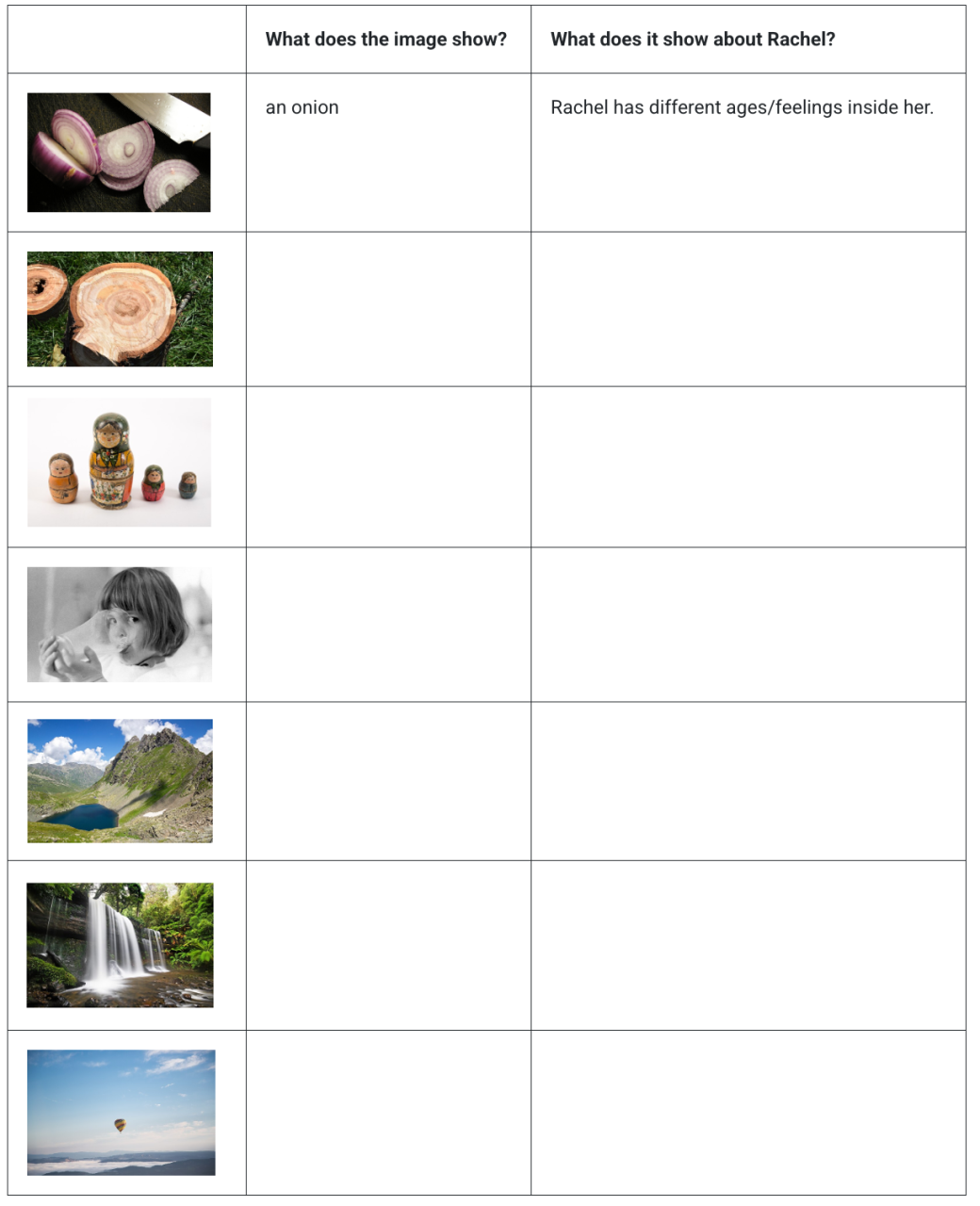
Esta actividad propone detenerse en algunas imágenes que Cisneros utiliza para representar la experiencia de Rachel. Se invita a las y los estudiantes a volver al texto para localizar cómo aparece cada imagen, explorar qué tienen en común y cómo contribuyen a construir los pensamientos y la experiencia de la protagonista.
Look at the images. Find references to them in the story. What do they tell us about Rachel?
Copy the chart in your folder and complete it.
Fuente de imágenes: Wikimedia Commons.
Many ideas are mentioned over and over again. List them and think:
What ideas and feelings do they evoke?
La repetición puede abordarse desde su efecto a partir de la voz de la narradora: ¿qué palabras o pensamientos vuelven una y otra vez?, ¿en qué momentos aparecen?, ¿qué permiten comprender sobre Rachel? La reflexión sobre el lenguaje se integra a la interpretación de la experiencia de la protagonista.
1. You're eleven, you're also ten, and nine, and eight, and seven, and six, and five, and four, and three, and two, and one.
2. When she thinks about how the sweater does not belong to her, she thinks, “Not mine, not mine, not mine”.
3. She reminds herself that she is “eleven, eleven,”
4. And that everyone will sing “Happy birthday, happy birthday to you.”
PART C: After reading
Soundtrack of Rachel’s emotions.
Esta actividad propone relacionar las interpretaciones construidas y generar una producción creativa. En grupos, las y los estudiantes seleccionan canciones que puedan vincular con el cuento, y justifican sus elecciones. Se sugiere que cada grupo presente brevemente sus elecciones y explique qué parte del cuento relacionan con cada canción y por qué.
Imagine a film director wants to make a film of “Eleven”. Which songs could be part of the soundtrack?
Work in groups. Choose 3 songs that match Rachel’s emotions in the story. Be ready to explain your choices to the class.
Song title & artist
Lines/phrases from the song
Connection with the story
We have chosen “…” by …
This song connects to the part when…
It shows that …
We chose this song because…
Evaluación formativa
A lo largo de la secuencia, las respuestas, los intercambios y las producciones de las y los estudiantes permiten recoger evidencias de sus aprendizajes y orientar las intervenciones docentes. Se podrá observar especialmente si las y los estudiantes:
anticipan sentidos y revisan sus hipótesis a partir de la lectura;
localizan información relevante y vuelven al texto para fundamentar sus respuestas;
realizan inferencias sobre los personajes, las situaciones y las emociones;
relacionan diferentes partes del cuento;
reconocen algunos recursos utilizados por la autora y pueden explicar su efecto;
participan en intercambios orales retomando ideas propias y de pares;
establecen relaciones entre la experiencia de Rachel y otras experiencias.